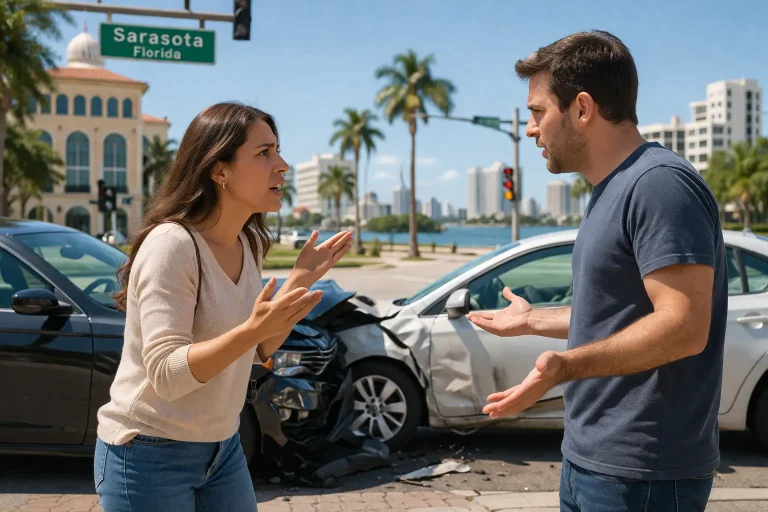
A wrong crash report can shape a Florida insurance claim before the full evidence is reviewed. Here is what can realistically be corrected, what may only be clarified, and what to do if the report will not be changed.
If a Florida crash report gets an important detail wrong, the biggest problem is usually not the paperwork itself. It is that the report can start shaping the insurance claim before you have a fair chance to respond. That can happen after a rear-end crash on U.S. 41 in Sarasota, an intersection collision in Bradenton, or a highway wreck near North Port just as easily as anywhere else in Florida.
That does not mean the report controls everything. Some mistakes can sometimes be corrected or clarified after the report is filed. Others may not be rewritten the way a driver hopes. The key question here is what kinds of report errors can realistically be corrected, and what to do when they cannot.
In Florida injury claims, that distinction matters early. Insurance adjusters often review the accident report at the beginning of the claim, sometimes before they have the photos, witness information, medical records, or other evidence that tells the fuller story. When an important fact is wrong, the claim may start from the wrong premise.
Summary: Crash Report Correction Basics
- Some Florida crash report errors can be corrected or clarified, but disputed narratives are harder to change than factual mistakes.
- Wrong names, vehicle details, or omitted passengers are usually easier to address than disagreements about lane position, turn sequence, or crash sequence.
- A correction request should be specific and supported with photos, video, witness information, or other documentation tied to the exact error.
- Many drivers expect the officer to simply rewrite the report, but that often does not happen when the disagreement is about how the crash happened.
- If the report mistake is already affecting fault or how the insurance company is viewing the case, it may be time to speak with a lawyer.
Can You Correct Any Florida Crash Report Error?
Not every mistake in a Florida crash report is the same. Some are minor clerical problems. Others affect how the accident is described and may be harder to correct. For this article, the key issue is whether the error can realistically be corrected or clarified after the report is filed.
How to Tell What Kind of Crash Report Problem You Have
Most people dealing with a wrong crash report fall into one of three categories:
- a clerical or factual error, such as a wrong name, wrong vehicle detail, or omitted passenger
- a narrative dispute, such as disagreement over lane position, turn sequence, or how the collision happened
- a claim-impact issue, where the report error is already affecting how the insurance company is evaluating fault
Knowing which type of problem you have helps you understand what may be corrected directly, what may be harder to change, and when the issue has grown beyond the report itself.
Can You Correct a Florida Crash Report After It Is Filed?
Sometimes, yes, but usually only in a limited way.
Clear factual mistakes are the most likely to be corrected or clarified. If the issue is something objective and verifiable, there may be a path to ask the reporting agency about a correction or supplemental clarification. In practice, that often means an agency may be more open to addressing an objective error in the report than to changing an officer’s narrative judgment about how the collision happened.
Factual Errors Are Easier to Address Than Narrative Disputes
A typo, wrong passenger name, or other clear factual problem is different from saying the report got the crash sequence wrong. For example, correcting a name or vehicle detail after a crash in Sarasota is very different from trying to change how the report describes who turned, who stopped, or how the collision happened at a busy Bradenton intersection. In the second situation, the officer may not rewrite the report the way you want, even if the report leaves out important context.
A rear-end crash report that lists the wrong vehicle or leaves out a passenger is one kind of issue. A report that says a driver changed lanes when photos show the vehicle was already stopped in traffic is another. That second kind of problem is usually harder to fix through a simple correction request.
A Crash Report Clarification May Be Limited
That is why people need to think about two separate goals:
- whether the report itself can be corrected
- how to prevent the wrong version from controlling the insurance claim
Those are not always the same thing.
This is where many Florida drivers get frustrated. A reporting agency may be willing to address a clear factual mistake, but far less willing to rewrite a disputed narrative about how the crash happened. Even when a driver raises a legitimate concern, the insurance company may still begin evaluating the claim based on the original report unless stronger supporting evidence answers the problem.
A clarification may be as limited as reporting a factual error, asking that supporting information be noted, or trying to correct a specific detail rather than expecting the entire narrative to be rewritten.
If the wrong version stays in place early, an adjuster may start asking questions from the wrong assumption, delay accepting liability, discount a witness, or treat the case like a comparative-fault dispute sooner than it should.
Many people searching for how to correct a Florida accident report are really dealing with a larger problem: the police report after a car accident is wrong, and they are worried the insurance company will use it against them. That is a fair concern. A crash report can influence the early direction of a claim, but it does not automatically decide fault and it does not replace the underlying evidence. If you want a closer look at how claim-impact issues play out, read our related article on how mistakes in a Florida crash report can affect your claim.

What to Do If Your Florida Crash Report Gets the Accident Wrong
Start by identifying the exact error. Do not say only that the whole report is wrong. Be specific about the detail you believe should be corrected or clarified.
Then gather whatever supports your position, such as scene photos, vehicle-damage photos, dash cam footage, witness information, repair records, or other documentation showing the mistake clearly.
Once you know the exact error and have support for your position, contact the reporting agency in a calm, specific way and ask what process is available for reporting a factual mistake or requesting clarification.
It is usually better to do this promptly, while details, witnesses, photos, and other supporting information are still easier to gather and organize. That is especially true after crashes in places like Sarasota, Bradenton, or North Port, where traffic conditions, lane position, and intersection movement may become harder to sort out as time passes.
What If the Officer Will Not Change the Crash Report?
That happens more often than people expect.
Many people expect that once they explain the mistake, the officer will simply rewrite the report. In practice, that often is not how it works when the disagreement is about narrative judgment rather than a factual entry.

Sometimes the report gets corrected, and sometimes it does not. If the officer will not rewrite the narrative, that does not end the issue. The next step is to preserve your documentation and make sure the claim is supported by the evidence, not just the wording in the report.
That is an important point for injured drivers in Sarasota, Bradenton, North Port, and across Southwest Florida. Many people assume the report decides everything. It usually does not. But if the mistake affects fault, such as which vehicle entered the intersection first or where traffic was stopped, it still needs to be answered quickly and with real support.
What Evidence Can Help Support a Crash Report Correction?
The most useful evidence is usually the kind that helps show a specific factual mistake clearly.
- Scene photos may help show vehicle position, traffic conditions, or where the impact happened.
- Vehicle-damage photos may help challenge the reported crash sequence.
- Dash cam footage may help resolve timing, movement, or lane position.
- Witness information may matter when the report leaves out who saw the turn, stop, or sequence of events.
- Repair records may help support the mechanics of the collision.
The more specific the documentation is to the exact error being challenged, the more useful it tends to be.
When to Talk to a Lawyer About a Wrong Florida Crash Report
Not every error requires legal help. But some situations are more serious than they first appear.
It may be time to speak with a lawyer when:
- the report shifts blame in a meaningful way
- an adjuster is already relying on the mistake
- a key witness was omitted
- the crash sequence is described incorrectly
- the error affects how your injuries are being understood
- the report problem is starting to affect settlement discussions
This is where experience matters. Not in a vague marketing sense, but in knowing which report problems are small, which ones are dangerous, and what evidence changes the conversation.
At Goldman Babboni Fernandez Murphy & Walsh, our firm brings over 150 years of combined experience, has recovered over $500 million for injured clients, and every case is handled by a senior partner rather than handed off.
That kind of experience matters when the question is whether a report error can still be corrected, clarified, or properly addressed before it creates bigger problems.
A wrong Florida crash report is not always fatal to a case. But when the mistake starts shaping fault, insurance position, or claim value, it needs to be taken seriously. If a crash report mistake is starting to affect the direction of your case, call (941) 954-1234 to speak with a senior partner.